

How the mastery indicator works
The four mastery levels, the four factors behind them, why the number can fall on its own, and how it gates the posttest.
Last updated: October 5, 2026
Four levels
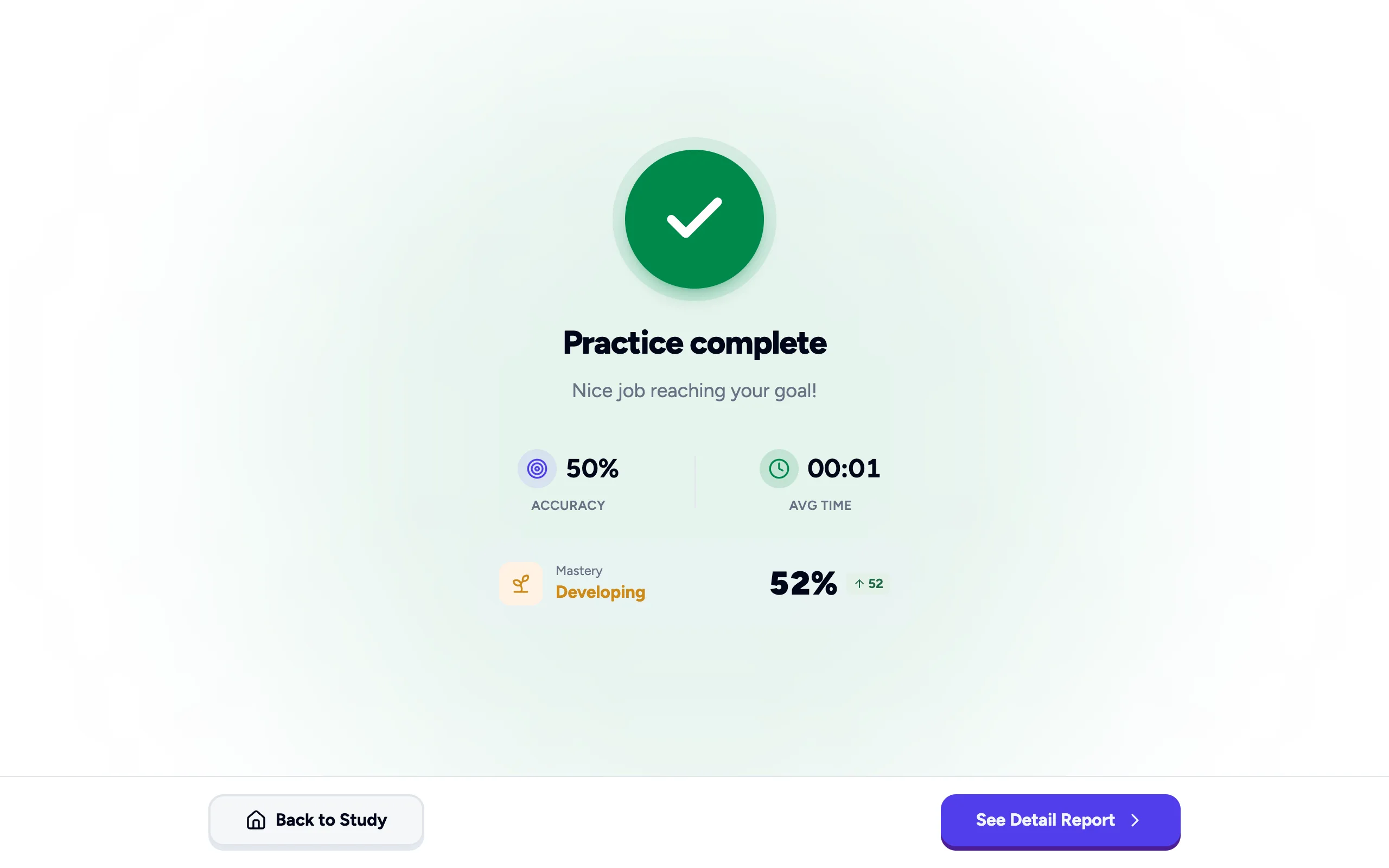
Every practice you have attempted carries a mastery badge showing a percentage for how strong your grip on it is, for example Developing · 52%:
- Needs Work, below 50%
- Developing, 50% to 69%
- Proficient, 70% to 84%
- Mastered, 85% and above
The badge shows on practice cards on the Study page and in the practice detail. Pretests and posttests have no badge. Hover over the badge to see its description. After a session, the Practice complete screen shows the mastery level and percentage, along with whether it went up or down.
On the Progress page, the subcourse journey card counts how many practices sit at each level and colours each practice's square by its level. You can open the How Mastery Works summary through the info icon on that card, or in the detail of a practice you have already done.
The four factors behind the number
It is not simply your last session's accuracy. Four main factors feed into it:
- Recent accuracy. Latest attempts weigh more than older ones.
- Consistency. Stable results rank higher than sharp ups and downs.
- Practice frequency. The more often you practise, the more confidence there is in the number.
- Time decay. Skills fade when you do not practise for a long time.
Your average speed per question also has a small influence.
Why it can drop without you doing anything
Because of the fourth factor. If a practice goes untouched for a long time, its percentage declines on its own. This is deliberate and not a penalty: language skills genuinely fade without repetition, so the number tries to be honest about where you are today rather than where you were three months ago.
How to raise it
Redoing a practice whose percentage has slipped usually lifts the number faster than starting a new one, because you improve recent accuracy and frequency at the same time. You can redo a practice any time, even one that is already Mastered.
How it connects to the pretest and posttest
Each part runs in order: pretest, practices, then posttest.
- The pretest is always open.
- The practices in a part open once that part's pretest is done.
- The posttest opens once the pretest is done and every practice in the part has reached Mastered at least once.
What counts for the posttest is whether a practice has ever reached Mastered. If that practice's badge later drops because you have not practised it for a while, a posttest that is already open does not lock again. Click a locked card to see which condition is still missing.